Explosions heard all over Iran as US strikes ...... Welcome to Glintnews......
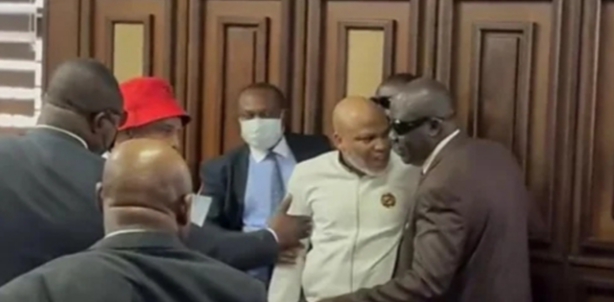
Show Us The Law!’ — Nnamdi Kanu’s Lawyer Challenges Conviction, Accuses Court Of Relying On Repealed Terrorism Law
June 10, 2026
A fresh legal battle has emerged over the conviction and life imprisonment of the leader of the Indigenous People of Biafra (IPOB), Nnamdi Kanu, as one of his lawyers, Barrister Christopher Chidera, has openly challenged the legal foundation of the judgment delivered by the Federal High Court in Abuja.
In a strongly worded public briefing titled “The Simple Question At The Heart Of Mazi Nnamdi Kanu’s Appeal,” Chidera argued that the central issue before the Court of Appeal is not whether Kanu’s criminal trial survived the repeal of Nigeria’s former terrorism legislation, but whether the law under which he was convicted remained legally valid at the time judgment was delivered.
The lawyer specifically questioned the decision of Justice James Omotosho, who convicted Kanu on terrorism-related charges, insisting that the Terrorism Prevention (Amendment) Act 2013 (TPAA 2013), which formed the basis of the prosecution, had already been repealed and replaced by the Terrorism Prevention and Prohibition Act 2022 (TPPA 2022).
According to Chidera, the repeal of the 2013 law is an undisputed fact, raising a constitutional question that the trial court allegedly failed to address.
The lawyer revealed that throughout several court sessions held on October 23, November 4, November 5, November 7 and November 20, 2025, Kanu’s defence team repeatedly invited the court to take judicial notice of the repeal of the terrorism law under Section 122 of the Evidence Act.
However, Chidera claimed that Justice Omotosho declined to properly examine the issue and instead proceeded on what he described as an “assuming without conceding” basis. According to him, this approach prevented the court from carrying out what he considers a crucial legal exercise of determining the exact written law in force at the time Kanu was convicted.
“The court never properly conducted the judicial-notice exercise necessary to establish which written law was actually in force for the purpose of conviction under Section 36(12) of the Constitution,” Chidera stated.
While acknowledging that the Terrorism Prevention and Prohibition Act 2022 contains a savings clause preserving ongoing cases and liabilities arising before the repeal of the previous legislation, Chidera argued that such a provision cannot serve as the substantive law under which a person is convicted.
According to him, there is a fundamental distinction between preserving an existing criminal proceeding and identifying the law that defines the offence and prescribes punishment.
“A savings clause keeps the case alive. It allows proceedings to continue. But it does not define a crime, nor does it prescribe punishment. It cannot become the law under which a person is convicted,” he argued.
The lawyer maintained that the prosecution and the trial court relied heavily on the savings provisions without clearly identifying the specific offence-creating sections of the 2022 Act that allegedly justified Kanu’s conviction and sentence.
At the heart of the appeal, Chidera said, is Section 36(12) of the 1999 Constitution, which provides that no person shall be convicted of a criminal offence unless the offence is defined and the punishment prescribed in a written law in force at the relevant time.

According to him, the critical legal question is straightforward: Was there a written law in force on November 20, 2025 — the date Kanu was convicted — that clearly defined the offences and prescribed the punishment imposed on him?
“A repealed law is no longer a written law in force,” Chidera argued.
He further contended that although Section 6 of the Interpretation Act preserves rights, liabilities and pending proceedings after the repeal of legislation, it does not revive a repealed statute as a living criminal law capable of grounding a conviction.
“A savings clause may preserve a case. It may preserve obligations and liabilities. What it does not do is define offences or prescribe punishments,” he said.
Chidera also accused the trial court of failing to comply with its legal duty under Section 122 of the Evidence Act, which requires courts to take judicial notice of all laws in force in Nigeria, including the repeal of existing legislation.
According to him, courts do not require formal proof of statutes or repeals because they are expected to know and apply the law.
“Justice Omotosho skipped this exercise entirely. He refused to properly address the repeal and instead relied on assumptions. The exact written law authorising the conviction was never clearly identified,” the lawyer alleged.
In one of the most striking parts of his briefing, Chidera said Kanu consistently demanded a clear legal basis for his conviction throughout the proceedings.
“Mazi Nnamdi Kanu kept asking a simple question: ‘Show me the law,’” the lawyer stated.
“Not the savings clause. Not the repealed law. Not proof that the case could continue. He asked for the written law in force on November 20, 2025, that defined the offence and prescribed the punishment imposed on him.”
According to Chidera, that question remains unanswered and now lies at the centre of the appeal before the appellate court.
The lawyer maintained that the Court of Appeal now has the responsibility of determining whether a valid written law existed at the time of conviction to support the judgment delivered against the IPOB leader.
“If such a law can be identified, then the Court of Appeal can say so clearly,” Chidera said.
“But if no such law can be identified, then the constitutional implications of Section 36(12) must be confronted.”
He stressed that the appeal is not about whether Kanu’s criminal case survived the repeal of the former terrorism law, noting that both sides appear to agree that the proceedings could continue.
Instead, he argued, the real issue is whether the law relied upon to convict the IPOB leader remained legally operative after its repeal.
“That is the question Mazi Nnamdi Kanu asked from the beginning,” Chidera concluded.
“That is the question the trial court never answered. And that is the question the Court of Appeal must now answer: Show us the law.”
We keep you informed and involved with anything from breaking news to thought-provoking opinion articles.